
SciFi Mind - Issue 5
The Book of the New Sun - Part 3

I’ve mentioned in the earlier parts of this introduction to Gene Wolfe’s The Book of the New Sun (if you haven’t read them, check out Part 1 and Part 2) that Severian’s journey, while it has a basic structure based on his own actions, appears to meander a good deal. Just as he told us at the outset that he was to “back into the throne,” he also backs into one encounter after another. When I first read the novels, I grew impatient at these constant diversions from a more linear path in his life, but I soon came to see that these were not distractions from his goal but the means by which he came to find his place in the world of Urth.
Among Wolfe readers, I should add, there is a theory that the incidents, apparently random, which lead him to become the Autarch, have all been planned out in advance. I’ll come back to that idea later when talking about his encounters with extraterrestrial beings, sometimes called cacogens.
First, I want to talk about the role of women. There are moments when the writing, at least from Severian’s perspective, is surely sexist, but Wolfe goes well beyond his narrator’s gaze to bring out the full humanity of the women, despite the limitations of his protagonist’s narrative. These characters not only bring out different aspects of Severian’s often opaque personality but also help structure his journey to becoming Autarch. I’ll describe a few of the most important women and then describe the extraterrestrial and non-human characters who intervene and shape the course of Severian’s life.
Key Women in Severian’s Story
Thecla, an exultant or noblewoman, befriends Severian during the late period of his apprenticeship. As I mentioned in Part 2 of this essay, she was imprisoned in the tower of the torturer’s guild and scheduled for excruciation or torture, leading to death. Though it was not normal for anyone below the journeyman level to enter a prisoner’s cell, the Master of the guild permits Severian to serve Thecla her meals and have extended visits with her. He brings her books that she asks for, and they read stories together. Ultimately, they also have sex, though that is not made explicit until much later in the narrative. As the first woman he has loved, Thecla assumes enormous importance for him.
When he helps her hasten death long before the effects of her torture can end her life, Severian is sent into exile to become an executioner in a northern city. But before he gets there (there will be more than one novel’s worth of incidents diverting him from that goal), he is kidnapped and taken to the rural camp of the rebel Vodalus. After a grotesque ceremony, Severian absorbs Thecla’s memory and being in a profound way.
There are many times when her memories surface in his mind to help recognize something new in his experience but familiar in hers. At one point, her body and consciousness take over Severian’s briefly and help him identify a way to escape from a prison. So in many ways the two of them are combined in a lasting relationship beyond death.
Severian is drawn to almost every woman he meets as the story unfolds, and in his narrative voice he frequently compares the different types of attraction he feels for them. So, by definition, they are partly defined by his male gaze, and he often seems more concerned about “loosening their clothes” and having sex with them than paying attention to what they say. But these women characters nevertheless define themselves in their own agency, and the older Severian narrating the story often comments on his younger self’s more limited ideas about them. So they emerge as more rounded characters, even though we see them primarily in their relations with Severian.
Agia is an aggressive figure throughout this story. She encounters Severian when he comes to the “rag shop” that she and her brother Agilus run. The two of them trick him into accepting a challenge for a duel, which they do not expect him to survive. But he does, and Agilus turns out to be his challenger. When he fails to kill Severian, he runs wild, killing several bystanders. He is caught and must be executed by Severian. That official act turns Agia against him, and she tries and fails to kill him on several occasions, usually with the help of others. Yet she has also been attracted to Severian, as he is to her, and when he has a chance to kill her after a failed attempt on his life, he lets her go. She continues to play an important role, though one that is only fully revealed at the end of the story.
Dorcas is a young woman in her late teens who appears out of nowhere to pull Severian out of a lake he has fallen into in that strange botanic garden I mentioned in Part 2 where time and reality seem to change. The lake is a graveyard where bodies are sunk with lead weights but preserved by the composition of the water. The young woman barely recalls her name and has lost all the rest of her memory. She becomes quite close to Severian and they stay together as a couple through his time in the city of Thrax, where he is to serve his exile as executioner. Dorcas, though she feels close to Severian, is plagued by deeper feelings of loss that she cannot define. She also shares moments of spiritual insight with him. Unfortunately, when Severian does make love to her, Wolfe produces one of the most cringe-worthy sex scenes I’ve ever read. That aside, Dorcas remains one of the most important, if often forlorn characters, in these novels and someone who deepens Severian’s experience of life and himself.
Jolenta is another complex figure, though one who can easily be dismissed as a male fantasy. She enters the story after Severian meets the giant of a man, named Baldanders, who appears to be the slow witted servant of Doctor Talos. Talos presents himself as the leader of a traveling theater troupe into which he quickly brings Severian and Dorcas. When this group meet a serving girl in a tavern, Talos invites her to join them, and she agrees. Though we don’t see this in the narrative, Talos uses his special powers to transform the humble serving girl into a beautiful woman. She revels in being the center of male attention because it gives her a power she has never before experienced.
She discusses her sense of power during a walk with Severian after the performance of a play that Doctor Talus has written. Severian takes her for a ride in a boat shaped like a flower where she falls asleep, and, as we later find out, he has sex with her repeatedly. That’s clearly rape, though Severian never owns up to that until the later book, Urth of the New Sun.
Jolenta’s story ends tragically as Talos, when the troupe members are about to go their separate ways, uses his magical cane to whip her and so begin the process of taking away the beauty he has given her. She gradually withers and never returns to her former life. It’s a dreadful story of the use and discarding of a woman solely to meet the fantasies of men, but while she is at the height of her beauty, Jolenta enjoys and uses the power that she briefly possesses.
There are many more women characters who play a variety of roles in Severian’s life, but each one is important in some way, however brief the interaction. While Wolfe can certainly be accused of misogyny, most of these characters have their own agency and reveal new dimensions in Severian’s experience.
Cacogens, Robots and Monsters
As Severian moves toward assuming the role of Autarch, his progress is facilitated or hindered by several characters who are not exactly human. I mentioned Doctor Talos, who is actually a creation of Baldanders. With his fox-like face, Talos is a playwright, a scientist and a kind of surgeon, as seen in his ability to transform Jolenta. Far from being a dim-witted servant, Baldanders is the master. He has turned himself into a giant through gruesome experiments on living humans. He has also had contact with a group of extraterrestrials in the search for technology to allow him to transcend human limits.
A man named Jonas becomes an important companion, but while trying to heal a wound of his body, Severian discovers that he has many metal parts. Eventually it becomes clear that it is the biological parts of Jonas, including his face, that were taken to repair the damaged metal structure, not the reverse. He is a robot who feels he must leave this world in order to repair himself fully. And so he escapes into a different dimension and time by stepping through a set of facing mirrors that have been created by the mysterious figure called Father Inire.
Inire has been the primary counselor to numerous autarchs in the past, and toward the end of the story it is revealed that he is an extraterrestrial, known as a Hierodule or, deprecatingly by humans, as a cacogen. (“Cacogen”, on the model of the word “cacophony” (“bad sound”), means something like “bad birth.”) Father Inire is one of a small group of Hierodules who chose to remain on Urth in human form to play various roles. Once Severian becomes the Autarch, it is a letter from Father Inire that sketches out a larger plan that has been guiding his journey. But while Inire and some extraterrestrials have been helping Severian, there are others who have been trying to end his life.
I’ve mentioned Agia and her hope to revenge the death of her brother by killing Severian. She enlists the help of a bizarre character, who is also of extraterrestrial origin, called Hethor. When he first meets Severian, just before the execution of Agilus, he speaks the most dazzling and bloodthirsty speech, declaring himself a fan of the torturer and urging him on to extremes of cruelty. In reality, he follows Severian and conjures strange monsters out of a mirror device to pursue and kill him. One of the worst of these is known as the salamander, a squat entity that can rear up to deploy intense heat and destroy people by burning them to death.
Another mysterious being is the “real” apparition of Master Malrubius, who was one of the human Masters of the guild of torturers and an early instructor of Severian but who died before the beginning of this story. He seems to be called into being by an act of intense thought and imagination. It is Malrubius who, at a couple of critical moments, tries to prepare Severian for the tests he must endure as Autarch. He emphasizes to his former pupil exactly what is at stake and the kinds of choices before him.
For attaining the role of Autarch is far from the final achievement in Severian’s life. Like autarchs before him, he must endure a test that will determine whether or not Urth can receive a new sun and renew the life of humanity. And this will occur in another universe, called Yesod. But the journey to that place is the subject of a separate book in this universe, The Urth of the New Sun.
Getting Started with The Book of the New Sun
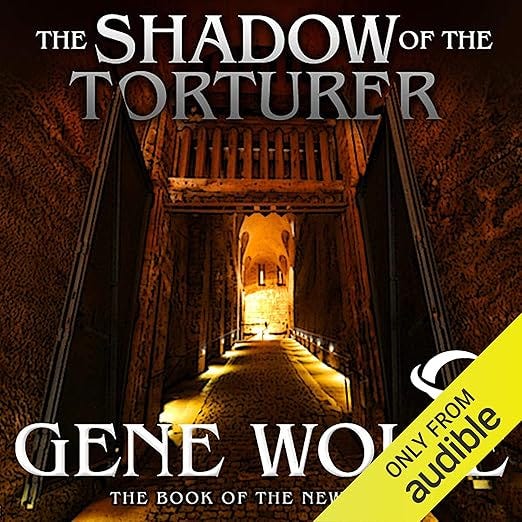
Gene Wolfe’s writing can be elusive in its meaning on its largest, what-does-it-all-mean scale, but I find it rich and involving chapter by chapter. The Book of the New Sun rewards repeated readings, and it does take a while to get a full picture of all the action in four novels covering close to a thousand pages. That’s why I have read it on the page, but also listened to the series in excellent audiobooks from Audible.com.
In both print and ebook format, the first two novels (The Shadow of the Torturer and The Claw of the Conciliator) are combined under the title Shadow and Claw. Similarly, the third and fourth books (The Sword of the Lictor and The Citadel of the Autarch) are combined as Sword and Citadel.
Michael Andre-Driussi has written two companion works that are helpful for checking on the meaning of obscure words and learning about Wolfe’s source material. These are Lexicon Urthis and Gene Wolfe’s The Book of the New Sun: A Chapter Guide. The latter is much more than just a summary; it also provides background reference information that Wolfe likely drew on for his writing.
I hope this three-part overview gives you some idea of the depth and range of this remarkable novel. For me, it’s one of the science fiction classics. Severian is a strange and difficult character, but his story draws me back again and again.
I'll be interested to see if you get drawn into these books as I have been. Despite the odd things, mysterious references and some of the treatment of women, I find the narrative voice captivating, so I keep coming back to reread. Hope you enjoy them!
I discovered The Book of The New Sun by accident ✨️ I'd just finished listening to James Lailey narrate all 9 Bernard Sampson books written by Len Deighton (and Winter makes 10 - to be read after the 3rd or 4th) and I was so impressed with the narrator that I searched for other titles he narrated. The New Sun books were downloaded and started listening. What a surprise! I'd never even heard of Gene Wolfe. I have the books now irl but have yet to read them... They are on the list.