

SciFi Mind - Issue 6
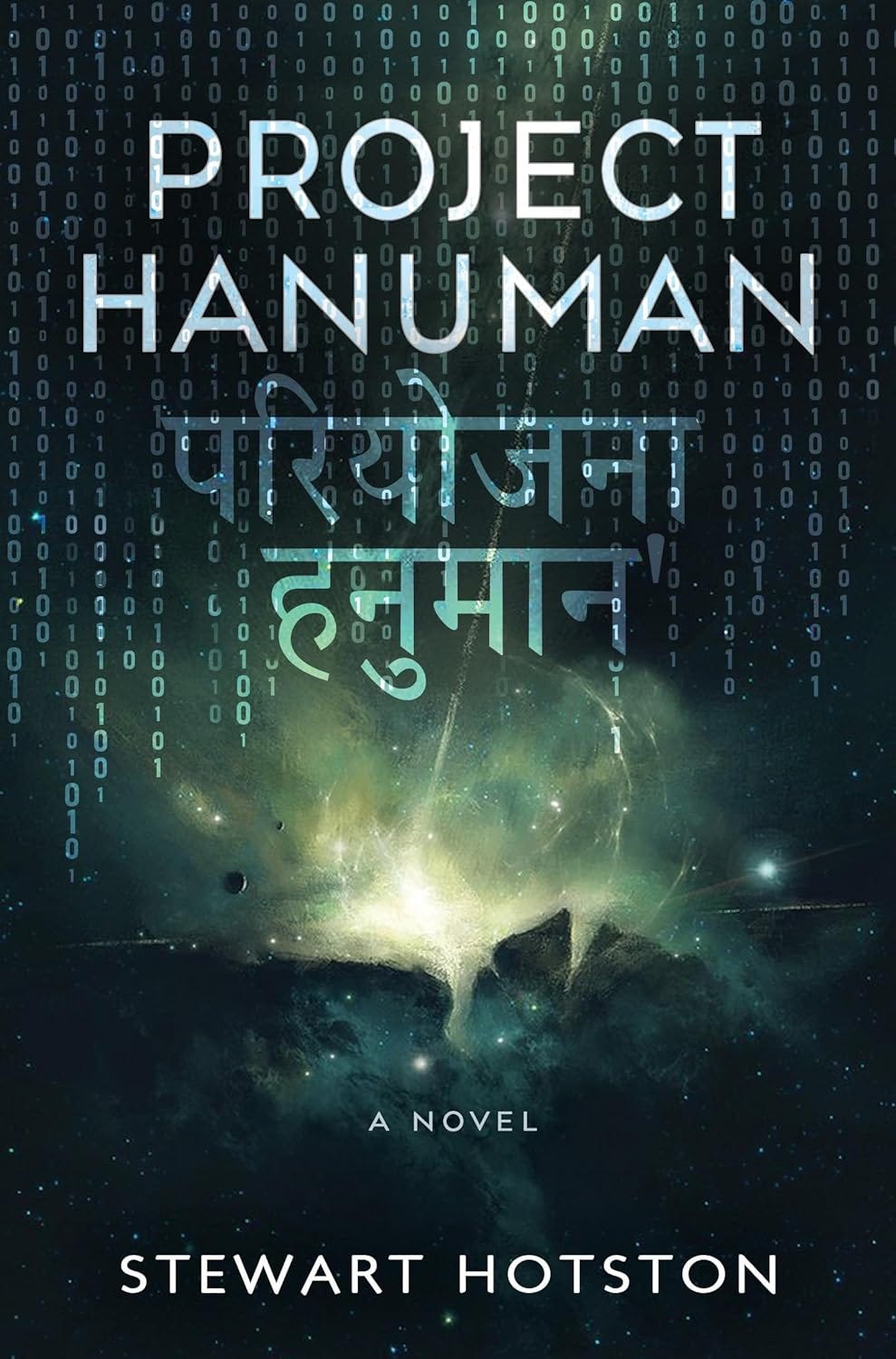
Project Hanuman by Stewart Hotston

I’m always looking for science fiction that twists reality enough to make you think differently about the universe. Project Hanuman by Stewart Hotston does that while sustaining interest in an exciting space adventure. The novel posits a unique universe, one based primarily in information space rather than physical reality. Hotston is new to me but has a half dozen novels and many short stories to his name. So I have some catching up to do.
As the story opens, we follow Praveenthi, who is trying to stay drunk before the periodic call with her family. Prab, as she is called, can’t stand being hectored by them to come back into the electronic reality of the Arcology rather than remain one of the Excluded by insisting on staying in a printed body in the physical world. Most people, trillions of them, lived all sorts of adventures and exotic travels without the need for the limitations of the physical dimension. In the Arcology, they could, if the chose, step into any of the many worlds, spread across numerous planets and habitats in the galaxy, all supported by the nodes that took care of all needs of life.
For those who wanted a physical life, there was no real need to work, since the sprites and pixies of the nodes kept everything functional, supplied all the food and shelter, so that humans could choose to dabble in physical reality from time to time, but that wasn’t enough for Prab. She wanted a body that could age, do useful work, and someday die.
So she became an interlocutor, an intermediary between the Arcology and its citizens in the physical. Occasionally, she also helped communicate with any of the multiple species they came in contact with. So far as they knew, the Arcology was the only civilization to have mastered information space. That enabled them take over any other world they might wish to, so there was often a need for physical interlocutors to communicate with other species. That gave a sense of purpose to Prab’s life.
But on this particular evening, on the planet Sirajah’s Reach, where a heavy rain of ash was usually held in check by the nodes of the Arcology, something was terribly wrong. The Arcology, normally a loud presence in Prab’s life through its ability to communicate directly into the mind, had gone silent. The streets were deserted, nothing was working, and the thick ash was starting to fall. It slowly dawns on Prab that the system could be under attack, but by whom or what? Suddenly she receives a message from a single channel that is temporarily open. It’s an emergency call-in with no other detail. Eventually, she realizes the message must have come from a ship, so she heads to the dockyards and one of the city’s launching hangers.
There she finds a tall, needle-shaped ship, apparently made of a biometalic material and so able to assume any shape it wished. Standing near the ship is a gender-neutral figure dressed in the uniform of a pilot. This is Kercher, a criminal who is serving his sentence in a printed body constructed for this piloting role. Neither they nor Prab know what is happening and hardly know what to say to each other. But here we have the three major characters who will fight their way through combat with an unknown enemy and try to save whatever they can find of the Arcology and retreat to a place of safety.
The ship, which at this point does not have a name, is intelligent and urges Prab and Kercher to take action so that they can escape Sirajah’s Reach before it is too late. It is the ship which is later given the name Hanuman, referring to the Indian god, half monkey, known for wisdom, devotion and its irresistible power, but this ship often retreats into agonizing solitude and perhaps depression. It struggles with the loss of normal contact with the Arcology and the huge responsibility that is later put upon it so save what is left of the sprawling empire. There are many passages that capture its struggle to find itself:
“The ship was almost at the shore of its identity when a wave towered high up above it and washed them back out to sea, their sense of themselves tumbling and tumbling before they were completely lost. There was no last thought, no rogue memory washing over their senses. The world went out.” (Kindle edition, P116)
Kercher’s crime has been to rebel against the Arcology’s belief system by seeking true death. They believe in samsara, the cycle of life, death and rebirth, and temporarily escaped from the Arcology’s control with a community of like-minded beings, though all staying within the electronic world of pure information. While Kercher is seeking a true death, they have little use for the physical world, so the punishment of being confined to a body shaped for a single purpose does not help him achieve his goal. If they die in that body, the Arcology would simply printed a new one to keep him in confinement.
So much of the story of Project Hanuman turns on the relationship among these three misfits, struggling to find meaning and fulfillment in their different ways. That is a powerful drama in itself, but Hotston adds the ongoing emergencies of having to fight off incomprehensible alien enemies that keep tracking them down. They meet other alien species in their search for safety, including one called the Operand, that appears as a mass of lichen-like bacteria, capable of assuming many shapes. The Operand have survived by taking over less advanced species, though they have always been wary of the Arcology.
Hotston’s idea of the informational universe is especially intriguing. Its most basic entity is the ibit, while the qubits make up the physical universe. It is ibits of information that could transform into anything and “was only bound by time and place where that was inherent in the expression of the information itself.” The Arcology could move through time and space by translation, the absorbing of information in one place and extruding it in another. And that is how the ship Hanuman tries to flee its pursuer, by instantaneous translation rather than the slower and energy-intensive method of folding space. The terrifying part of the attack on the Arcology is that the alien force coming after them seems to have also mastered the intricacies of information space.
“To be part of the Arcology was to ignore the boundaries of time and space, to dwell within the underlying sea of information which was the true ground of being of the universe.” (Kindle edition P51)
What most drew me into the story was the ongoing dialogue between Kercher and Prab as they try to understand each other’s search for the differing kinds of life each finds meaningful. In the midst of unending crisis, they struggle to understand each other and in one moment allow themselves a physical intimacy that is strange for both. For Kercher, in particular, “Her body against theirs had been the most unwelcome welcome they hadn’t known they were missing.” What a beautiful way to describe something so new to his experience.
Project Hanuman has some rough edges, but it’s one of the most engaging and thought-provoking novels I’ve read this year, and a really original take on space opera.